Analysis of a Google Ads Grant Campaign: Strategy, Patience, and Tangible Results
- What it is: Google Ads Grant gives eligible nonprofits up to $10,000/month in Search ad credits.
- The challenge: stricter policies than paid campaigns; small mistakes can suspend or limit the account.
- The key: patience + continuous A/B testing on keywords, ads, and structure.
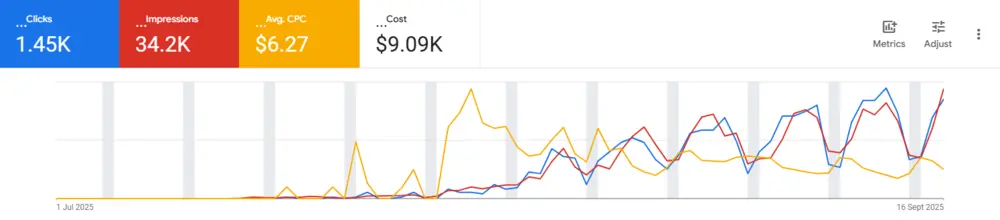
- Case study results: ~1.45K clicks, 34.2K impressions, average CPC stabilized at $6.27, with focus on conversions (donations, volunteering, newsletters).
- For whom: organizations that want free credits to drive real actions—not just traffic.
Google Ads Grant for Nonprofits: An Obstacle Course That Rewards Patience
Do you run a nonprofit and want more online visibility? You have probably heard of Google Ads Grant—Google’s program that gives eligible nonprofits free advertising credits to promote their mission. At first glance it looks perfect: free ads to reach a wider audience and raise awareness for your cause. But like any powerful tool, Google Ads Grant comes with real challenges.
What is Google Ads Grant and why does it matter?
Google Ads Grant provides eligible organizations with up to $10,000 per month in advertising credits for campaigns on Google’s Search Network. The goal is to help nonprofits:
- grow brand awareness;
- attract new volunteers;
- raise donations;
- promote events.
Unlike standard Google Ads campaigns, Grant campaigns have clear limits: a maximum cost-per-click bid and restricted ad positions. Knowing these rules is the first step to avoid wasting credits.
Startup hurdles: getting past Google’s policies
Launching a Google Ads Grant campaign is not straightforward. Many organizations hit a wall of policy-related issues. These rules are much stricter than for paid campaigns and require careful setup and deep knowledge of the guidelines.
Campaigns are often suspended or fail to get enough coverage because of mistakes that look minor but actually break policy. That is where a clear strategy and expert management become essential—you cannot simply switch campaigns on and wait.
The turning point: when patience and strategy start to pay off
Like a seed that needs time to grow, a Google Ads Grant campaign needs patience and a methodical approach. Our experience across many successful accounts shows that the key is a strategy built on continuous A/B testing. There is no magic formula—only steady experimentation with keywords, ads, and campaign structure.
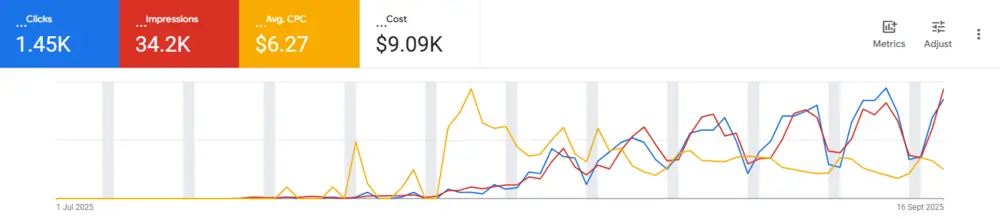
Looking at the chart from one of our campaigns, you can see a typical growth path that shows how consistent work leads to concrete results.
Slow start (July 2025)
The first weeks are often spent getting the engine running, clearing policy obstacles, and collecting early data. Results are low but essential for the next phase: without that data foundation you cannot optimize keywords or messaging.
Steady rise in clicks and impressions (August–September 2025)
As the chart shows (blue and red lines), after the testing phase activity rises significantly. Clicks (1.45K) and impressions (34.2K) grow steadily, showing the campaign is reaching a wider audience. That increase is a signal that the chosen keywords and ads are working.
Falling average cost-per-click (Avg. CPC)
The most important metric is average cost-per-click, which stabilizes at $6.27. Despite higher activity, we keep optimizing spend so each click becomes more efficient. The yellow cost line on the chart, with some fluctuation, shows spend managed so it stays within Grant limits.
Careful conversion management
Traffic numbers are not enough. Real success is measured in conversions—both digital (e.g. newsletter sign-ups) and offline (e.g. donations or volunteer applications). Ongoing data analysis lets us optimize the campaign for concrete actions that support the organization’s mission, not only for clicks.
Why work with a specialized digital marketing agency?
Running a Google Ads Grant account needs specific skills and constant monitoring. Superficial management can lead to account suspension or wasted credits. A specialized agency can make the difference by offering:
- Grant policy expertise: deep knowledge of the rules and strategies to clear early blockers.
- Continuous A/B testing and optimization: data-driven changes to maximize results over time.
- Focus on conversions: campaigns built to generate real actions, not just traffic.
If you lead a nonprofit and want to make the most of Google Ads Grant, do not leave it to chance. Professional management turns an opportunity into tangible results for your cause.
Frequently asked questions about Google Ads Grant
1. What is Google Ads Grant and who is it for?
Google Ads Grant is a Google program that gives eligible nonprofits up to $10,000 per month in Search Network ad credits. It helps grow brand awareness, attract volunteers, raise donations, and promote events.
2. What are the main limitations of Google Ads Grant?
Grant campaigns have a maximum CPC bid and can only appear in certain positions. Policies are stricter than paid campaigns: even minor violations can suspend or limit the account. Careful setup from day one is essential.
3. How long does it take to see results with Google Ads Grant?
In our experience, the first weeks are spent clearing policies and collecting data. A meaningful increase in clicks and impressions often comes after 1–2 months of continuous A/B testing on keywords, ads, and structure.
4. Which metrics matter most in a Grant campaign?
Beyond impressions and clicks, average CPC (stabilized at $6.27 in this case study), compliance with Grant budget rules, and especially conversions matter most: newsletter sign-ups, donations, volunteer applications. Traffic without real actions does not support the mission.
5. Why hire an agency to manage Google Ads Grant?
Managing a Grant account requires deep policy knowledge, continuous A/B testing, and a focus on conversions. Superficial management risks suspension or wasted credits. A specialized agency reduces those risks and turns free credits into measurable results for your cause.